
A Bank of Baroda employee in Ahmedabad has been arrested for allegedly stealing Rs 8.7 crore from an RBI currency chest and laundering the money into properties and cryptocurrency.

State-owned Engineers India and MECON as well as four private entities are in the fray for the project to comprehensively revamp RBI's currency management infrastructure in order to cater to future cash needs of the country's fast growing economy. The four private entities are: Accenture Solutions; Colliers International (India) Property Services; PricewaterhouseCoopers and The Boston Consulting Group (India).
.jpg)
Chests are select branches of banks authorised by RBI for distribution of notes and coins.

Unidentified men posing as central government officials intercepted a cash van in Bengaluru and allegedly fled with about Rs 7 crore. Police are investigating the incident and have formed teams to hunt for the suspects.

All lenders, including public, private, rural and cooperative banks, have been asked to make arrangements to gather information on deposits of the Specified Bank Notes.

The Reserve Bank of India has now said failure to report such cases might lead to penal action.

Filling of Rs 100 and Rs 200 notes result in faster depletion and more frequent cash replenishment. This will cost banks and managed service providers more.
.jpg)
The penalty was levied in connection with deficiencies and lapses in the operation and maintenance of the currency chest at the Secunderabad branch of SBI, it said. Last month, the RBI had imposed a penalty of Rs 3 crore (Rs 30 million) on SBI for violating know your customer/anti-money laundering norms.
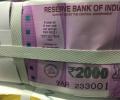
The Reserve Bank on Monday advised banks to provide shade from the sun and water to customers waiting to exchange or deposit Rs 2,000 notes. It can be noted that during the note ban in 2016, there were allegations of customers dying while waiting in queues to exchange bank notes. Following Friday's announcement of withdrawing Rs 2,000 notes -- the notes continue to be legal tender unlike demonetisation exercise -- there were concerns about customers facing inconvenience, especially given the summer being at its peak.
The specifics will also cover what's fit and proper to be a chest manager; the insurance and re-insurance aspects; and the new capital threshold, which is Rs 100 crore now.
RBI has maintained the stock of currency through advance as well as current printing level

'RBI is taking all steps to complete the process expeditiously so as to release firm figures at an early date.'

The Reserve Bank on Friday superseded the board of the city-based Abhyudaya Cooperative Bank on concerns emanating from "poor governance" and appointed an administrator to manage the affairs of the lender. In what can be seen as a step that should allay depositors' concerns, the central bank did not put any restrictions or moratorium on deposit withdrawals because of the comfort it gets on the bank's finances, according to people in the know. "(The) action is necessitated due to certain material concerns emanating from poor governance standards observed in the bank.
The notes, kept in about a dozen currency chests of commercial banks in Mumbai, are now being dried and counted before being shredded by the Reserve Bank of India.

T K S Elangovan has alleged senior bank officials forged documents and faked authorisation from the RBI, to transport huge sums of hawala money during recent elections in the state.

The theory that all banned notes will come back into the system may not be true. Anup Roy finds out.

"The window (for NRIs) is open till June 30 in which people can deposit cash. And after adding all these, we will give out the number," Mundra said.
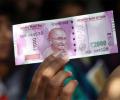
Jaitley said the Rs 500 and Rs 1,000 notes returned to currency chests of the RBI amounted to Rs 12.44 lakh crore

Small queues were witnessed at some bank branches on Tuesday for the exchange of Rs 2,000 notes against smaller denominations as part of the withdrawal exercise. As per the RBI guidelines issued on Friday, the exchange of Rs 2,000 facility is available from Tuesday. A person can exchange up to a limit of Rs 20,000 at a time without filling any form or requisition slip.

On a daily basis, an average cash logistics company transports Rs 5,000-8,000 crore worth of cash nationwide.

I kept insisting that Rs 100 notes were in short supply and there was an urgent need to augment the supply of 100 rupee notes while also rapidly bringing into circulation the proposed new Rs 500 notes. But this was easier said than done because all the note printing machines of the RBI were programmed for printing Rs 2,000 notes and required at least three weeks before the machines could print the new Rs 500 currency notes. The availability of currency paper posed another major bottleneck, and it had to be imported. It was decided to immediately start printing the Rs 500 notes. It was only when the supply of the new Rs 500 notes started improving and the process of change of cassettes at the ATMs gathered momentum that the situation began limping back to normal. A fascinating excerpt from former SBI chairman Rajnish Kumar's The Custodian of Trust: A Banker's Memoir, five years after demonetisation, November 8.

If the high security notes introduced in 2015 were kept in the system, the pain due to demonetisation can be ameliorated to a certain extent. But unfortunately, such thought process have no place in the hasty demonetisation decision.

'The current crisis is a result of a clash between a coercive attempt by the government to justify demonetisation and rising digital transactions against the market and the economy fighting the unexpected pressure from atop.'

86.69 per cent of available stock of currency notes is being taken away from circulation and less than one-fourth of these are being replenished by newly printed Rs 2,000 notes

Declaring demonetisation a complete failure may turn out to be hasty, argues economist Ashok K Lahiri.
The SBI said its officials were ferrying Rs 570 crore after the Reserve Bank of India asked them to, to address a temporary cash shortage in Andhra Pradesh.
'Today may be the last day for depositing old notes, but tomorrow all the worries of the banks will not go away.' 'As long as there is cash shortage, banks will not be able to function normally.' 'Nobody knows when the shortage will be over.'

Those who consider the rupee as a proxy for virility have started thumping their chests and dreaming of dethroning the dollar from its coveted position, observes Tamal Bandyopadhyay.

With inflation remaining at elevated levels, central banks around the world, including the Reserve Bank of India (RBI), will kill excess demand in economy over the next six to eight months, sources in the know said. They also indicated that there could be a rate hike in June, when the inflation forecast for the current financial year would be raised. The RBI, the sources said, might announce more steps such as raising the limit on held-to-maturity (HTM) bonds to support government borrowings but might not come out with any further quantitative easing GSAP (Government Securities Acquisition Programme) measures.

If struggling with dealing with queues of people asking for new notes wasn't enough, banks are now facing the challenge of storing the old notes in their strong rooms.
The Reserve Bank of India on Thursday said banknotes in circulation witnessed higher than average increase during 2020-21, on account of precautionary holding of cash by people due to the COVID-19 pandemic, and its prolonged continuance. The value and volume of banknotes in circulation increased by 16.8 per cent and 7.2 per cent, respectively, during 2020-21, as against an increase of 14.7 per cent and 6.6 per cent, respectively, witnessed during 2019-20, said the RBI annual report. In value terms, the share of Rs 500 and Rs 2,000 banknotes together accounted for 85.7 per cent of the total value of banknotes in circulation as on March 31, 2021, as against 83.4 per cent as on March 31, 2020.

The currency with the public is 10.3 per cent higher than it was in the week preceding November 8, 2016 - from Rs17.97 trillion to Rs18.76 trillion.

With about 2,000 qualified engineers to service ATMs across the country, it is an uphill task to modify 220,000 machines.

"Post demonetisation, during November 9, 2016, to January 10, 2017, more than 1,100 searches and surveys were conducted and more than 5,100 notices were issued by the income tax department for verification of suspicious high-value cash deposits," Finance Minister Arun Jaitley said in a written reply in the Lok Sabha on Friday.

There is not much bank employees can do, but some words of encouragement from the management would have helped. Stretched working hours and the tense atmosphere is taking a toll on their health.

He said it may take up to 3 weeks for all the 2 lakh cash vending ATMs to operate normally as each one has to be calibrated individually to dispense new sized notes of Rs 2000 and Rs 500 besides lower denomination currency of Rs 100.

There will be a lot to repair and rejuvenate -- if that opportunity even presents itself, warns Rathin Roy.

The surge is a stark turnaround from 2013 when the country's current account gap hit a record high due to outflows on expectations the US Fed would rein in its stimulus programme
